
What is AI
You’ve heard people talking about AI everywhere—in news headlines, at work, in conversations about technology. Maybe you’ve used it without realizing it when your phone recognized your face, when Netflix suggested a show you’d love, or when spam emails disappeared before reaching your inbox.
But what actually is AI? Not the science fiction version with robots taking over the world—the real technology that’s already part of your daily life in February 2026.
If you’re completely new to artificial intelligence and feel confused by technical jargon or overwhelmed by complex explanations, this guide is for you. We’ll break down what AI actually means, how it works in simple terms, what it can and can’t do, and why it matters for your everyday life—all without assuming you have any technical background.
Understanding what AI is doesn’t require a computer science degree. It just requires clear explanations that respect your time and intelligence.
Who This Guide Is For (And Who It’s Not For)
This explanation helps you if:
- You’ve heard about AI constantly but don’t actually understand what it means
- You want a beginner-friendly explanation without technical jargon
- You’re curious how AI affects your daily life and work
- You need foundational knowledge before exploring specific AI tools or applications
This might not be what you need if:
- You already understand AI basics and want advanced technical details
- You’re looking for specific AI tool recommendations (not foundational concepts)
- You want to learn programming or build AI systems yourself
- You’re researching AI for academic or professional technical purposes
What Is AI in Simple Terms
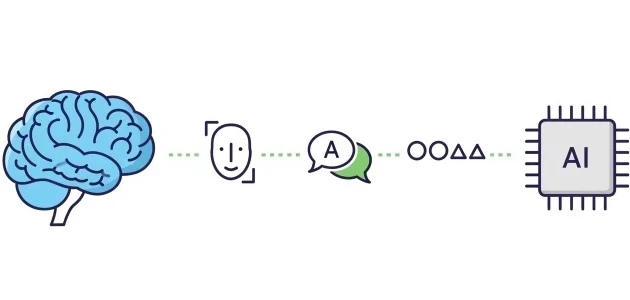
Artificial Intelligence (AI) is a field of computer science focused on creating smart machines that can perform tasks that typically require human intelligence, like learning, reasoning, and problem-solving.
Here’s an even simpler way to think about it: AI is teaching computers to do things that usually require a human brain—like recognizing faces, understanding speech, making decisions, or learning from experience.
The key difference between AI and regular computer programs is learning ability. Traditional software follows exact instructions programmed by humans. If you want it to do something different, a programmer must write new code.
AI systems, however, can learn and improve on their own by looking at examples and patterns. Just like you learned to ride a bike without receiving a manual for every situation you might face while cycling, AI systems learn from experience rather than following step-by-step instructions for every possible scenario.
A Practical Example
Think about how your email spam filter works:
Old-fashioned approach: Programmers write rules like “if email contains word ‘viagra,’ mark as spam.” This catches some spam but misses clever variations.
AI approach: Show the system thousands of examples of spam and legitimate emails. The AI learns patterns—certain word combinations, suspicious links, formatting tricks—and gets better at identifying spam even when spammers try new tactics.
The AI wasn’t programmed with explicit rules for every type of spam. It learned what spam looks like by studying examples.
How AI Actually Works (Without the Technical Jargon)
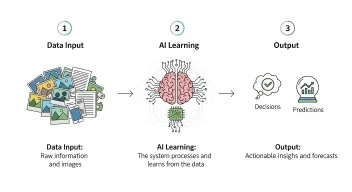
You don’t need to understand the complex mathematics behind AI to grasp how it functions. Here’s what’s happening at a basic level.
AI Learns from Data
Modern AI, especially machine learning, works by learning from data without being explicitly programmed for every detail. The more examples an AI system sees, the better it typically performs.
For example:
- A face recognition system trains on millions of photos of different faces
- A voice assistant trains on recordings of people speaking in various accents and contexts
- A recommendation engine trains on data about what millions of users watched, liked, or purchased
AI Finds Patterns
Humans are good at recognizing patterns, but AI can find patterns in massive amounts of data that humans would never spot—patterns too complex, too subtle, or hidden in datasets too large for human analysis.
When you show AI thousands of pictures of cats and dogs, it learns subtle differences: ear shapes, nose structures, body proportions, fur patterns. Eventually, it can identify cats versus dogs in photos it’s never seen before.
AI Makes Predictions or Decisions
Once trained on data and patterns, AI systems make predictions or decisions about new information:
- Will this email user click on this ad? (Prediction)
- Is this credit card transaction fraudulent? (Decision)
- What movie would this person probably enjoy? (Recommendation)
- What does this person’s voice command mean? (Understanding)
The AI isn’t “thinking” like humans think. It’s recognizing patterns it learned during training and applying them to new situations.
Different Types of AI You Encounter Daily
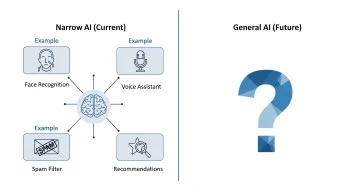
AI isn’t one single technology—it’s a broad field with different approaches and capabilities. Here are the main types you should know about.
Narrow AI (What We Have Now)
Artificial Narrow Intelligence (ANI) is the only form of AI that currently exists. ANI models are designed to perform a single, specific task, such as identifying images, engaging in chat, or filtering emails.
Every AI you interact with today—voice assistants, facial recognition, spam filters, recommendation systems, navigation apps—is narrow AI. It’s excellent at its specific task but can’t do anything outside that narrow focus.
Siri can answer questions and set reminders but can’t drive a car. A chess-playing AI that beats grandmasters can’t recognize faces or write emails. Each AI is specialized.
Machine Learning
Machine learning is the method that makes most modern AI possible. Machine learning is the method to train a computer to learn from its inputs but without explicit programming for every circumstance.
Think of machine learning as the “learning” part of artificial intelligence—how AI systems improve through experience rather than human programming.
There are different ways AI can learn:
Supervised learning: The AI learns from labeled examples (this is a cat, this is a dog, this is spam, this is not spam).
Unsupervised learning: The AI finds patterns in unlabeled data on its own (grouping customers with similar behaviors without being told what the groups mean).
Reinforcement learning: The AI learns by trial and error, receiving rewards for good actions and penalties for bad ones (how AI learns to play games or control robots).
Deep Learning
Deep learning is a more advanced type of machine learning inspired by how human brains work. It uses artificial “neural networks” with many layers that can learn increasingly complex patterns.
Deep learning powers many AI breakthroughs you see in 2026:
- Language understanding in conversational tools
- Image recognition in photos and videos
- Voice recognition in smart speakers
- Medical diagnosis from scans
- Autonomous vehicle navigation
You don’t need to understand how neural networks function technically. Just know that deep learning enables AI to handle very complex tasks that simpler approaches can’t manage.
If you’re interested in how AI tools apply these technologies to improve your daily productivity, our guide on what is AI productivity and how it actually works explores practical applications.
General AI (What Doesn’t Exist Yet)
You might have heard about “Artificial General Intelligence” or AGI—AI that can understand, learn, and apply knowledge across any domain like humans can.
This doesn’t exist yet. Strong AI, also known as “artificial general intelligence” (AGI) or “general AI,” would possess the ability to understand, learn and apply knowledge across a wide range of tasks at a level equal to or surpassing human intelligence. This level of AI is currently theoretical and no known AI systems approach this level of sophistication.
When news articles speculate about AI threatening jobs or society, they’re usually discussing hypothetical AGI, not the narrow AI we actually have today. Keep this distinction clear to avoid unnecessary anxiety about current AI capabilities.
What AI Can Actually Do (Real Capabilities)
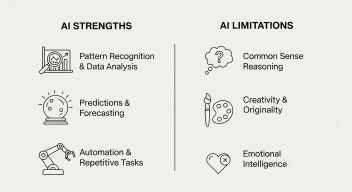
Understanding AI’s genuine abilities helps set realistic expectations. Here’s what AI handles well in 2026.
Tasks AI Excels At
Pattern recognition: Identifying faces in photos, recognizing objects, detecting fraud, diagnosing diseases from medical images.
Language processing: Understanding spoken commands, translating between languages, answering questions, summarizing text.
Predictions: Forecasting weather, predicting traffic patterns, estimating delivery times, suggesting products you might like.
Automation: Filtering spam, adjusting photo lighting, routing customer service inquiries, scheduling meetings.
Data analysis: Finding trends in massive datasets, identifying correlations humans would miss, generating insights from complex information.
Creative assistance: Helping write drafts, generating image variations, suggesting design elements, creating music snippets.
AI performs these tasks faster and often more consistently than humans, especially when dealing with large volumes of repetitive work or massive datasets.
Where AI Still Struggles
Common sense reasoning: AI often lacks basic understanding that humans take for granted. It might answer factual questions correctly but fail at simple logic that requires real-world knowledge.
Creativity and originality: AI can remix, combine, and vary existing patterns, but truly original creative thinking—the kind that produces breakthrough innovations—remains primarily human.
Emotional intelligence: Understanding complex human emotions, reading social cues accurately, providing genuine empathy—these are areas where AI falls short.
Explaining its reasoning: Many AI systems can’t explain why they made a particular decision, which creates problems in fields requiring transparency and accountability.
Handling unexpected situations: AI trained on specific data struggles when encountering scenarios very different from its training. Humans adapt; AI often fails.
Understanding context deeply: AI might miss subtle context, sarcasm, cultural references, or nuanced meanings that humans grasp automatically.
Being aware of these limitations prevents disappointment and helps you use AI more effectively by understanding where human judgment remains essential.
Common AI Myths vs. Reality
Separating fact from fiction helps you think clearly about AI without unnecessary worry or unrealistic expectations.
Myth: AI is sentient or conscious
Reality: Current AI has no consciousness, feelings, or self-awareness. It processes patterns and produces outputs based on training, but it doesn’t “think” or “feel” in any meaningful sense.
Myth: AI will take all our jobs soon
Reality: AI changes jobs more than it eliminates them entirely. While some tasks become automated, new roles emerge, and most jobs transform to incorporate AI tools rather than disappearing completely.
Myth: AI is always right or objective
Reality: AI inherits biases from its training data and can make mistakes. If an AI learns from biased examples, it produces biased results. AI isn’t inherently more accurate or fair than the data it learned from.
Myth: AI understands what it’s doing
Reality: AI recognizes patterns and generates responses but doesn’t comprehend meaning the way humans do. It can write coherent text without “understanding” it.
Myth: AI development is slowing down
Reality: AI capabilities continue advancing rapidly in 2026, with new improvements in reasoning, efficiency, and practical applications appearing regularly across research and commercial deployments.
Understanding these realities helps you evaluate AI tools and claims more critically.
How You’re Already Using AI Without Realizing It

AI isn’t just futuristic technology—it’s embedded in tools you use daily.
Your smartphone: Face unlock, voice assistants, photo organization, autocorrect, app recommendations, battery optimization.
Email: Spam filtering, smart reply suggestions, priority inbox sorting, scheduling assistance.
Shopping: Product recommendations, price predictions, fraud detection, customer service chatbots, search result ranking.
Entertainment: Netflix/Spotify recommendations, YouTube suggestions, social media feeds, gaming opponents, content moderation.
Navigation: Real-time traffic predictions, route optimization, estimated arrival times, alternate route suggestions.
Banking: Fraud detection, credit scoring, customer service automation, investment recommendations, transaction categorization.
Healthcare: Diagnostic assistance, medical image analysis, drug discovery research, appointment scheduling, symptom checkers.
You interact with dozens of AI systems weekly without necessarily thinking “I’m using AI.” It’s increasingly invisible infrastructure supporting services you rely on.
Getting Started with AI as a Complete Beginner
If you want to understand AI better or start using it intentionally, here’s where to begin without getting overwhelmed.
Start with Tools You Already Use
Before exploring new AI tools, notice the AI features in software you currently use:
- Gmail’s smart compose and reply suggestions
- Your phone’s photo search and organization
- Spotify or Netflix recommendations
- Google Maps traffic predictions
Understanding how these work builds intuition about AI capabilities without requiring new software.
Try Accessible AI Tools
In 2026, several user-friendly AI tools help beginners explore capabilities:
Conversational assistants: Tools that respond to questions in natural language, helping you find information, explain concepts, or assist with tasks through conversation.
Image tools: Applications that enhance photos, remove backgrounds, generate variations, or organize your photo library automatically.
Writing assistants: Software that helps draft emails, check grammar, suggest improvements, or generate content ideas.
Productivity tools: Applications using AI to schedule meetings, summarize documents, transcribe recordings, or automate repetitive tasks.
Start with one tool addressing a specific need rather than trying to learn everything simultaneously. For guidance on choosing tools that fit your needs, our article on best AI productivity tools for beginners provides practical starting points.
Learn by Experimenting
The best way to understand AI is using it yourself. Try asking the same question different ways and notice how responses change. Test AI tools on various tasks and observe where they excel versus struggle.
This hands-on experience builds practical knowledge about AI strengths and limitations better than reading theory alone.
Don’t Expect Perfection
AI tools make mistakes, misunderstand context, or produce nonsensical outputs sometimes. This is normal. Learning to recognize when AI responses are unreliable and verifying important information builds critical AI literacy.
Stay Curious But Critical
AI evolves rapidly. What’s true about capabilities today may change by next year. Maintain curiosity about new developments while applying critical thinking to claims about what AI can achieve.
Important Considerations About AI
As you learn about and use AI, keep these factors in mind.
Privacy and Data
AI systems learn from data—often massive amounts of it. When you use AI services, consider:
- What data are you providing?
- How is that data being used and stored?
- Who has access to information you share?
- What privacy controls exist?
Read privacy policies for AI tools handling sensitive information, and be thoughtful about what data you provide.
Bias and Fairness
AI trained on biased data produces biased outputs. This matters in high-stakes domains like hiring, lending, criminal justice, and healthcare.
While ANI offers many benefits, it also carries risks, as poor training data can lead to biased or inaccurate outputs, which can be critical in applications like loan approvals, hiring decisions, and predictive policing.
As an AI user, remain aware that “AI-generated” doesn’t mean “neutral” or “fair.” Human oversight remains essential for important decisions.
Energy and Environment
Running AI systems, especially training large models, requires significant computing power and energy. As AI usage grows, its environmental impact becomes a consideration worth understanding.
Job Market Changes
AI automates certain tasks and transforms many job roles. Rather than causing mass unemployment, AI typically changes what jobs involve—automating routine aspects while creating demand for new skills.
Staying adaptable and learning to work alongside AI tools positions you better for evolving job markets.
Frequently Asked Questions
Is AI the same as robots?
No, though they’re related. AI refers to the intelligence—the ability to learn, reason, and make decisions. Robots are physical machines. Some robots use AI (like self-driving cars), but most AI exists in software without any physical robot form (like recommendation systems or voice assistants). You can have AI without robots, and you can have robots without AI.
Do I need to learn programming to use AI?
Not at all. While building AI systems requires programming skills, using AI tools designed for regular users requires no coding knowledge. Most consumer AI applications work through simple interfaces—you type questions, upload files, or click buttons. Understanding what AI is helps you use tools more effectively, but you don’t need technical skills.
Can AI really be creative, or is it just copying?
AI generates outputs by learning patterns from existing data, so in a sense it’s always working from examples it has seen. However, it combines and remixes patterns in ways that can produce novel results. Whether this counts as “true” creativity is debated, but AI can certainly assist human creativity by generating variations, overcoming blocks, and suggesting ideas you might not have considered.
Is my job going to be replaced by AI?
Most likely, AI will change aspects of your job rather than replace it entirely. Tasks involving routine pattern recognition or data processing may become automated, but jobs requiring human judgment, creativity, emotional intelligence, or complex problem-solving remain primarily human. The best approach is learning how AI tools can enhance your work rather than viewing AI as direct competition.
How do I know if information from AI is accurate?
Always verify important information from AI systems, especially for facts, dates, statistics, or critical decisions. AI can generate confident-sounding responses that are incorrect. Cross-check with authoritative sources, use your judgment about plausibility, and remember that AI is a tool to assist research and thinking—not a replacement for verification and critical thinking.
Our Authority Sources
This article draws on authoritative sources to ensure accuracy and clarity for beginners:
IBM – What Is Artificial Intelligence – Comprehensive explanation from a leading technology company with decades of AI research and development, providing technically accurate yet accessible definitions.
Google Cloud – What is Artificial Intelligence – Educational resource from Google, a major AI developer, explaining fundamental concepts in beginner-friendly language with real-world context.
Britannica – Artificial Intelligence – Established encyclopedia providing scholarly yet accessible explanations, regularly updated with current developments as of 2026.
NASA – What is Artificial Intelligence – Government agency perspective on AI definitions and applications, offering authoritative technical framework without marketing bias.
Wikipedia – Artificial Intelligence – Comprehensive, community-maintained resource with extensive citations and historical context, useful for foundational understanding and further exploration.