
Is ChatGPT plus worth it?
You’re looking at the ChatGPT Plus pricing page, wondering if $20 per month makes sense when the free version already handles your basic questions.
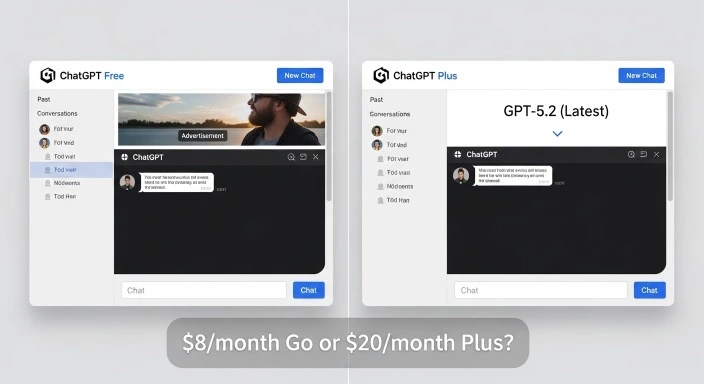
The decision feels more complicated now than it did a year ago. OpenAI introduced new pricing tiers in early 2026—there’s now a Free plan (with ads), ChatGPT Go at $8/month, Plus at $20/month, and Pro for serious users. GPT-5.2 replaced GPT-4 as the flagship model, bringing three different modes: Instant, Thinking, and Pro. The landscape shifted significantly.
The question isn’t just “free versus paid” anymore. It’s about which tier matches your actual usage patterns and whether the capabilities you gain justify the monthly cost.
This guide examines whether ChatGPT Plus is worth it in 2026, comparing all current pricing tiers, explaining what changed with GPT-5.2, and providing a practical framework to determine which option makes financial sense for your situation.
Who This Is For (And Who It’s Not For)
This guide helps you if:
- You currently use ChatGPT regularly and wonder if upgrading makes sense
- You’re trying to choose between Free, Go, Plus, or Pro tiers
- You want to understand what GPT-5.2 actually offers compared to free models
- You need honest analysis about whether $8, $20, or more per month provides real value
This probably isn’t necessary if:
- You rarely use ChatGPT (a few times monthly for simple questions)
- You’re completely satisfied with the free tier and don’t experience limitations
- Budget constraints make any subscription cost unrealistic right now
- You’re looking for extremely specialized features neither tier provides
Is ChatGPT Plus Worth It? The Core Question Answered
Before diving into features and pricing tiers, let’s address the central question directly: is ChatGPT Plus worth the $20/month in 2026?
The honest answer: it depends entirely on three factors—how frequently you use ChatGPT, what tasks you’re performing, and whether GPT-5.2’s advanced capabilities matter for your specific work.
Here’s what changed since 2025 that affects this calculation:
GPT-5.2 replaced GPT-4 as the current model across all paid tiers. This represents a genuine capability leap, not just incremental improvement. According to OpenAI’s announcement, GPT-5.2 achieves state-of-the-art performance across professional knowledge work tasks, with expert judges rating it equal to or better than human professionals on 70.9% of comparisons OpenAI.
New pricing tiers emerged. You’re no longer choosing between just “free” and “Plus.” ChatGPT Go launched in January 2026 at $8/month, positioning itself between free and Plus. This middle option includes GPT-5.2 access but shows ads and has lower usage limits than Plus.
Free tier now includes ads. As OpenAI confirmed in mid-January 2026, both free users and Go subscribers now see advertisements within ChatGPT, while Plus, Pro, and Enterprise users maintain ad-free experiences SlashGear.
These changes mean the value equation shifted. The decision isn’t as simple as “pay for better AI” anymore—it’s about selecting the right tier for your usage intensity and tolerance for limitations.
Throughout this comparison, we’ll examine actual differences between tiers, real-world performance scenarios, and provide a decision framework to determine whether Plus specifically justifies its cost for you.
Understanding the Current ChatGPT Pricing Tiers (February 2026)
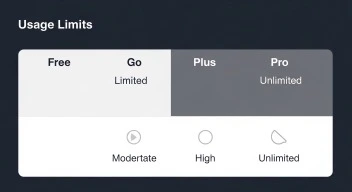
OpenAI’s subscription structure now includes four distinct tiers, each targeting different user needs.
ChatGPT Free (With Ads)
Cost: $0/month
What you get:
Access to GPT-5.2 Instant, the fast everyday model introduced in the GPT-5 series. This handles basic queries, simple writing tasks, quick research, and general questions adequately.
Limited message capacity that resets periodically. OpenAI doesn’t publish exact numbers, but free users report hitting limits after sustained use during a single session.
Advertisements displayed within the interface. According to OpenAI’s announcement, ads appear separately from responses and never influence ChatGPT’s answers, but they’re present and noticeable.
Standard response speed during peak hours. When servers experience heavy traffic (typically US business hours), free users wait longer or receive “at capacity” messages.
Basic web browsing and image generation with restrictions. These features work but come with stricter limits than paid tiers.
Best for: Casual users who check ChatGPT occasionally for straightforward questions and can tolerate ads and usage limits.
ChatGPT Go ($8/Month)
Cost: $8/month
What you get:
Full access to GPT-5.2 Instant and GPT-5.2 Thinking modes. This is the significant upgrade—you get the reasoning capabilities of GPT-5.2 Thinking, which handles complex analysis much better than Instant alone.
Higher usage limits than free tier. You can send substantially more messages before hitting caps, though limits still exist (lower than Plus).
Ads still appear. Go subscribers see advertisements just like free users—the $8 primarily buys you better models and higher limits, not ad removal.
Priority access during peak times compared to free users. You’re not at the front of the queue like Plus subscribers, but you skip ahead of free tier when servers are busy.
Enhanced web browsing and DALL-E access with better limits than free.
Best for: Regular users who need GPT-5.2’s capabilities but can tolerate ads and don’t require the highest usage limits or fastest speeds.
ChatGPT Plus ($20/Month)
Cost: $20/month
What you get:
Access to all GPT-5.2 modes: Instant, Thinking, and Pro. GPT-5.2 Pro represents the most capable option for complex work where quality matters more than speed.
Ad-free experience. Plus subscribers see no advertisements anywhere in ChatGPT.
Highest usage limits among standard subscriptions. You can send approximately 80+ messages per 3-hour window with GPT-5.2 (exact limits vary by mode and server load).
Priority access during all times. You essentially skip the queue whenever servers are busy.
Early access to new features and experimental capabilities before they reach lower tiers.
Full Codex access with 2x rate limits during limited-time promotions. Codex provides agentic coding capabilities for development work.
Custom GPTs creation and access to GPT Store for specialized versions tailored to specific tasks.
Advanced data analysis—upload files for ChatGPT to analyze, create visualizations, and work with complex datasets.
Best for: Professional users who rely on ChatGPT daily for work, need consistent access without interruptions, and benefit from GPT-5.2 Pro’s advanced capabilities.
ChatGPT Pro ($200/Month)
Cost: $200/month
What you get:
Everything in Plus, plus significantly higher usage limits and access to the most computationally expensive reasoning modes.
Unlimited GPT-5.2 Pro usage (within reasonable use policy). This tier removes practical limits for even extremely heavy users.
Maximum reasoning effort available—the “xhigh” setting for GPT-5.2 Thinking that produces the most thorough analysis.
Best for: Power users, researchers, or businesses where ChatGPT represents a core productivity tool worth significant monthly investment. Most individuals don’t need this tier.
What GPT-5.2 Actually Brings to the Table
Understanding whether any paid tier is worth it requires knowing what GPT-5.2 delivers compared to what free users experienced previously.
Three Operational Modes
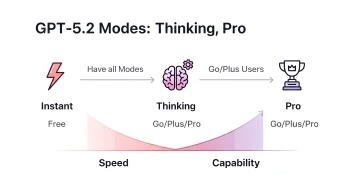
GPT-5.2 operates in three distinct modes, each optimized for different scenarios:
GPT-5.2 Instant serves as the everyday workhorse. It responds quickly, handles straightforward tasks efficiently, and maintains conversational tone. Think of it as the model you’d use for quick questions, basic writing assistance, simple explanations, or rapid iterations during brainstorming.
Free tier users get Instant only. Go, Plus, and Pro users can access all three modes.
GPT-5.2 Thinking engages deeper reasoning for complex work. When you need thoughtful analysis, multi-step problem solving, sophisticated coding, or careful consideration of nuanced situations, Thinking mode produces substantially better results. It takes longer to respond because it’s actually processing more thoroughly.
GPT-5.2 Pro represents maximum capability for the hardest problems. This mode uses the most computational resources and produces the highest quality outputs for extremely challenging tasks. Most users rarely need Pro mode, but when you do—complex programming, advanced analysis, intricate problem-solving—it outperforms the other modes noticeably.
August 2025 Knowledge Cutoff
All GPT-5.2 models share an August 2025 knowledge cutoff, giving them more current understanding than previous models. This means more accurate information about recent events, current tools and technologies, and contemporary context without needing web search as frequently.
Improved Long-Context Understanding
GPT-5.2 handles extended conversations and long documents better than GPT-4 or earlier models. According to OpenAI’s technical documentation, GPT-5.2 brings significant improvements in long-context understanding, making it better at maintaining coherence across complex, multi-turn conversations OpenAI.
In practical terms, you can have longer exchanges without the model “forgetting” earlier parts of your conversation, and you can paste longer documents for analysis without quality degradation.
Professional-Grade Performance
On benchmark tests measuring well-specified knowledge work across 44 occupations, GPT-5.2 Thinking performs at or above human expert level, beating or tying top industry professionals on 70.9% of comparison tasks OpenAI.
This doesn’t mean it replaces human expertise—it means for well-defined tasks with clear parameters, GPT-5.2 produces outputs comparable to what you’d get from a professional, but at much lower cost and higher speed.
Better Tool-Calling and Agentic Capabilities
GPT-5.2 improved significantly at using tools, following multi-step processes, and handling complex workflows that require the model to break down tasks, use different capabilities sequentially, and maintain coherent progress toward goals.
For coding work specifically, the introduction of GPT-5.2-Codex (available in Codex features for paid users) brings state-of-the-art agentic coding performance, as evidenced by its achievements on SWE-Bench Pro and Terminal-Bench 2.0 benchmarks designed to test realistic software engineering tasks OpenAI.
If you’re curious how ChatGPT’s latest capabilities compare to other leading assistants, our detailed analysis of ChatGPT vs Claude for daily tasks explores which tool excels at different types of work in 2026.
When ChatGPT Plus Actually Justifies Its $20/Month Cost
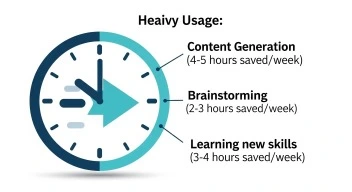
Let’s be specific about scenarios where Plus makes clear financial sense.
You Use ChatGPT Intensively for Professional Work
If ChatGPT assists with income-generating activities—writing, coding, consulting, research, business analysis, marketing—the subscription typically pays for itself within hours of saved time.
A freelance writer who saves 3-4 hours monthly through faster drafting and editing breaks even if their hourly rate exceeds $5-7. A developer who debugs code more efficiently or a consultant who researches faster sees similar returns.
Calculate your effective hourly value (what your time is actually worth, not just what you earn per hour). Multiply by hours saved monthly through ChatGPT Plus features. If that number exceeds $20, the math works.
You Hit Usage Limits Regularly on Free or Go Tiers
People who use ChatGPT multiple times daily for varied tasks—research, writing, problem-solving, learning—quickly encounter free tier message caps or find Go’s limits restrictive.
If you frequently see “you’ve reached your limit” messages or plan your ChatGPT usage around avoiding caps, Plus removes this friction entirely. The productivity loss from interrupted workflows often costs more than $20 in wasted time and mental overhead.
You Need Consistent Access During Your Working Hours
For users in North America or Europe working typical business hours, free tier performance degrades noticeably during peak times. You encounter slower responses, occasional capacity messages, or queue delays.
Plus subscribers skip the queue completely. If your work schedule aligns with peak usage times and interruptions disrupt productive flow, priority access alone can justify the cost.
GPT-5.2 Thinking and Pro Modes Materially Improve Your Output
Certain tasks benefit substantially from GPT-5.2’s advanced reasoning:
Complex analysis requiring consideration of multiple variables, competing factors, or nuanced implications works much better with Thinking or Pro modes.
Sophisticated coding projects involving architecture decisions, refactoring, or debugging complex systems leverage GPT-5.2-Codex’s agentic capabilities available through Codex features.
High-stakes writing where quality, tone, and subtle messaging matter significantly—business proposals, important communications, technical documentation—benefits from Pro mode’s additional thoroughness.
Research and learning in complex subjects where superficial answers don’t suffice gets better results from Thinking mode’s deeper processing.
If these scenarios describe 30-40% or more of your ChatGPT usage, Plus provides clear value beyond what Go offers.
You Value the Ad-Free Experience
This factor is subjective but legitimate. If advertisements in your work environment feel intrusive, unprofessional, or simply annoying enough to disrupt focus, the $12 difference between Go and Plus buys ad removal.
Some users find ads negligible. Others find them genuinely distracting during complex work requiring sustained concentration. Know which type you are.
You’re Replacing or Reducing Other Paid Tools
If ChatGPT Plus allows you to cancel or downgrade other subscriptions—writing assistants, research tools, coding helpers—the net cost might be zero or even negative.
Grammarly Premium costs $12/month. Jasper AI starts at $49/month. GitHub Copilot is $10/month. If ChatGPT Plus adequately replaces one or more of these for your use cases, the value proposition improves dramatically.
For a comprehensive look at which productivity tools ChatGPT Plus might replace in your workflow, see our guide on best AI productivity tools for beginners.
When ChatGPT Plus Probably Isn’t Worth It
Honesty requires acknowledging situations where $20/month doesn’t make sense.
Your Usage Is Genuinely Casual
If you use ChatGPT a few times weekly for simple questions, basic research, or occasional writing help, the free tier or Go subscription handles these tasks adequately.
You’re not hitting limits. You’re not frustrated by ads or occasional slower speeds. GPT-5.2 Instant available on free tier answers your questions fine.
Save your $20/month.
Free Tier Limitations Don’t Actually Affect You
Some users never encounter message caps despite regular use because their sessions are short and spaced out. Others work during off-peak hours when even free tier performs well.
If you’ve genuinely never been blocked by limits, denied access due to capacity, or wished for faster responses, you’re not experiencing the problems Plus solves.
GPT-5.2 Instant Meets Your Needs
For straightforward tasks—simple questions, basic writing assistance, quick explanations, elementary coding help—GPT-5.2 Instant (available free) performs adequately.
The capability difference between Instant and Thinking/Pro matters primarily for complex work requiring sophisticated reasoning. If your tasks don’t fall into that category, you’re paying for capabilities you don’t use.
Be honest about complexity. If Instant gives you 85-90% of what you need, Thinking or Pro mode’s incremental improvement might not justify the subscription cost.
Budget Makes $20/Month Meaningful
If $20 represents a significant portion of your discretionary spending or would stress your monthly budget, don’t subscribe to Plus.
ChatGPT is useful but not essential. Unlike software required for work or tools without free alternatives, ChatGPT offers functional free access. Prioritize financial stability over premium features.
You Can Use ChatGPT Go Effectively
The $8/month Go tier provides GPT-5.2 Instant and Thinking modes—the two modes most users actually need—while costing 60% less than Plus.
If you can tolerate ads and don’t require the absolute highest usage limits, Go delivers most of Plus’s core value at a substantially lower price. The $12 difference buys ad removal, higher limits, Pro mode access, and early features—meaningful but not always essential.
For many users, Go represents the sweet spot between free limitations and Plus’s premium price.
Real-World Usage Scenarios: Comparing Free, Go, and Plus
Let’s examine specific situations to illustrate when each tier makes sense.
Scenario 1: College Student Writing Research Papers
Free tier experience:
- GPT-5.2 Instant helps brainstorm topics and structure outlines effectively
- Can ask clarifying questions and get basic research assistance
- Ads appear but aren’t particularly disruptive for academic work
- Hit usage limits during intensive research sessions, forcing breaks
- Sometimes encounters capacity messages during evening hours (peak college student usage time)
Go tier difference:
- GPT-5.2 Thinking provides much better analysis of complex academic concepts
- Higher limits accommodate full research sessions without interruption
- Priority access reduces wait times during evening study hours
- Ads still present but doesn’t affect core functionality
- Cost: $8/month fits tighter student budgets
Plus tier difference:
- Ad-free experience feels more professional when working on serious papers
- GPT-5.2 Pro available for the most complex theoretical analysis
- Highest limits support marathon writing sessions
- Cost: $20/month harder to justify on student budget
Verdict: Go tier hits the sweet spot for most students—access to Thinking mode for complex analysis at a more affordable price. Plus makes sense only for graduate students working on thesis-level research or those with generous budgets.
Scenario 2: Professional Developer Building Client Projects
Free tier experience:
- GPT-5.2 Instant helps with basic syntax questions
- Hit usage limits quickly when debugging or working on substantial features
- Peak hour slowdowns occur during work hours (exactly when you need ChatGPT)
- Ads feel unprofessional when screen-sharing with clients
- Can’t access Codex features with agentic coding capabilities
Go tier difference:
- GPT-5.2 Thinking generates more reliable code with fewer bugs
- Higher limits support active development work
- Priority access improves availability during work hours
- Ads still present (still awkward during client calls)
- Still no Codex access
Plus tier difference:
- Ad-free experience appropriate for professional environment
- Codex features with GPT-5.2-Codex provide state-of-the-art agentic coding
- Highest limits accommodate full-day development sessions
- GPT-5.2 Pro tackles architectural decisions and complex refactoring
- Time saved debugging and planning easily justifies $20/month for professional rates
Verdict: Plus is worth it for professional developers. Time saved through better code generation, Codex capabilities, and interruption-free access pays for itself within hours at professional billing rates.
Scenario 3: Marketing Manager Creating Content
Free tier experience:
- GPT-5.2 Instant generates decent first drafts for social posts and emails
- Brainstorming campaign ideas works adequately
- Struggles maintaining consistent brand voice across longer content
- Ads interrupt workflow and look unprofessional in work context
- Hit limits during content creation sprints
Go tier difference:
- GPT-5.2 Thinking maintains brand voice more consistently
- Better at generating sophisticated long-form content
- Higher limits support content batch creation sessions
- Ads still present (not ideal for workplace tool)
- Cost manageable for small business or freelance budgets
Plus tier difference:
- Ad-free experience appropriate for professional marketing work
- Custom GPTs can be trained on specific brand guidelines
- GPT-5.2 Pro produces highest quality marketing copy
- Early access to features like improved image generation
- Higher output quality reduces editing time substantially
Verdict: Plus justifies cost if you’re producing substantial content regularly (several pieces weekly). Go works if budget is tight and ads don’t bother you. Free is inadequate for professional marketing work.
Scenario 4: Casual User Learning New Topics
Free tier experience:
- GPT-5.2 Instant explains new concepts clearly
- Answers follow-up questions patiently
- Provides good starting points for learning
- Ads present but not particularly disruptive for casual learning
- Usage limits only matter during marathon learning sessions
Go tier difference:
- GPT-5.2 Thinking handles more nuanced explanations
- Better at explaining exceptions, edge cases, and complexity
- Can engage with more advanced questions as learning progresses
- $8/month is modest cost for improved learning experience
Plus tier difference:
- Ad-free learning environment
- GPT-5.2 Pro available for deepest theoretical questions
- Custom GPTs could serve as specialized tutors
- $20/month harder to justify for casual learning
Verdict: Free tier works fine for casual learners. Go makes sense if you’re seriously committed to learning complex subjects and $8/month feels reasonable. Plus is overkill unless learning represents professional development where better understanding has career value.
If you’re comparing ChatGPT to other major assistants for everyday use, our breakdown of ChatGPT vs Google Gemini examines how these tools stack up across common tasks.
Hidden Costs and Limitations to Consider
Beyond the straightforward subscription price, factor in these considerations.
Message Limits Exist Even on Plus
ChatGPT Plus doesn’t provide unlimited messages. You get substantially higher limits than free or Go tiers, but intensive usage still encounters caps.
Plus users can typically send 80+ messages per 3-hour window with GPT-5.2 modes, with exact limits varying by which mode you’re using and current server load. For most people this is plenty. For extremely heavy users running extended sessions, it’s still a constraint.
If you plan to use ChatGPT Plus for continuous, intensive work sessions all day, understand these limits exist.
GPT-5.2 Thinking and Pro Are Slower Than Instant
Despite priority access, Thinking and Pro modes generate responses more slowly than Instant because they’re performing more sophisticated processing.
For tasks requiring quick back-and-forth iterations—rapid brainstorming, fast editing cycles, quick clarifications—this speed difference is noticeable. Plus includes access to Instant for these scenarios, but if you primarily need speed over depth, you’re not fully utilizing what you’re paying for.
Features Sometimes Experience Issues
Advanced capabilities like data analysis, web browsing, Codex, and image generation occasionally produce errors or unexpected results.
These features are powerful when they work but can frustrate when they don’t. Don’t expect enterprise-level reliability—you’re paying for access to advanced but imperfect consumer tools.
Your Needs Might Exceed Plus Capabilities
For some professional applications—especially business environments requiring security guarantees, extensive customization, API access, or team collaboration—ChatGPT Plus still falls short.
You might need ChatGPT Team ($25-30/user/month), ChatGPT Enterprise (custom pricing), or specialized industry-specific tools despite Plus access.
Don’t assume Plus solves all professional AI needs. It’s a capable individual subscription with limitations.
The Competitive Landscape Keeps Evolving
Google Gemini, Anthropic’s Claude, Microsoft Copilot, and other alternatives continuously improve. Features that justify ChatGPT Plus today might become available free elsewhere tomorrow.
The value proposition of any subscription shifts as competition intensifies. Stay aware of alternatives and be willing to reconsider your subscription choice periodically.
How to Decide: A Practical Framework
Use this systematic approach to determine which tier makes sense.
Step 1: Track Your Current Free Usage for One Week
Before upgrading, monitor:
How many times daily you use ChatGPT Whether you hit message limits and how often What times of day you typically use it (are you experiencing peak-hour congestion?) Whether tasks require sophisticated reasoning or simple answers suffice
If you rarely hit limits, work during off-peak hours, and find Instant adequate, you probably don’t need a paid tier.
Step 2: Identify Your Primary Use Cases
List the top 5 tasks you use ChatGPT for. For each, honestly assess:
Does this require GPT-5.2 Thinking or Pro’s advanced reasoning? Would interruptions from limits or capacity messages disrupt my workflow? Do ads affect my ability to work or the professionalism of my environment?
If most tasks answer “no” to these questions, stick with free. If several answer “yes,” a paid tier makes sense.
Step 3: Calculate Potential Time Savings
Estimate realistically how much time monthly you’d save with:
No usage limits interrupting your flow Faster, more capable responses requiring less editing Priority access during your typical working hours Ad-free environment eliminating small distractions
Multiply time saved by your effective hourly value (what your time is worth for work purposes).
If monthly time value saved > subscription cost, the math supports upgrading.
Step 4: Consider Go as the Middle Ground
Many users overlook ChatGPT Go, which provides GPT-5.2 Thinking (the mode most people actually need most often) at $8/month.
Ask yourself honestly: would Go’s capabilities meet 85-90% of my needs? Am I primarily paying the extra $12 for Plus to avoid ads and get slightly higher limits, or do I genuinely need Pro mode and maximum limits regularly?
For a significant portion of users, Go represents the value sweet spot.
Step 5: Try Go or Plus for One Month
Both subscriptions are monthly with no commitment. You can trial Go for $8 or Plus for $20, evaluate actual value delivered in your real workflow, and cancel if it disappoints.
The low switching cost makes experimentation relatively risk-free if the monthly cost isn’t financially stressful.
Decision Matrix
Choose Free if:
- You use ChatGPT casually (few times weekly)
- Simple tasks dominate your usage
- You don’t hit limits or experience capacity issues
- Ads don’t bother you
- Any subscription cost feels significant
Choose Go ($8/month) if:
- You use ChatGPT regularly (multiple times daily)
- You need Thinking mode’s capabilities for complex work
- You hit free tier limits but don’t need absolute maximum limits
- You can tolerate ads in exchange for lower cost
- Budget is moderate but not unlimited
Choose Plus ($20/month) if:
- You use ChatGPT intensively for professional work
- Ad-free environment matters for your use case
- You regularly need GPT-5.2 Pro for hardest problems
- You benefit from Codex features for development work
- Time saved easily justifies $20/month
- You want early access to new features
Choose Pro ($200/month) if:
- ChatGPT represents a core business tool
- You’re an extremely heavy user requiring essentially unlimited access
- Maximum reasoning effort for critical work justifies premium cost
- You’re a researcher, power user, or business where AI is central to operations
Frequently Asked Questions
Can I switch between tiers easily if my needs change?
Yes, you can upgrade, downgrade, or cancel your subscription anytime. Changes take effect at your next billing cycle. If you start with Go and realize you need Plus features, upgrading is straightforward. Similarly, downgrading from Plus to Go or canceling entirely involves no penalties—you simply lose access to premium features when your current billing period ends.
If I subscribe to Plus, do I still have access to GPT-5.2 Instant for quick tasks?
Yes, Plus subscribers can freely switch between all three GPT-5.2 modes: Instant, Thinking, and Pro. You’re not locked into using the slower Thinking or Pro modes for every query. Use Instant for quick questions where speed matters and reserve Thinking/Pro for complex work requiring deeper reasoning. This flexibility is actually one of Plus’s advantages.
What happens to my conversation history if I cancel my subscription?
Your conversation history persists whether you’re on free, Go, Plus, or Pro. If you cancel a paid subscription, you simply lose premium features (advanced models, priority access, ad-free experience) but retain all your previous conversations and data. You can resubscribe later without losing anything.
Are there student or educator discounts available?
As of February 2026, OpenAI does not publicly offer student or educator discounts for individual ChatGPT subscriptions. However, educational institutions can inquire about ChatGPT Enterprise or Team pricing for faculty and students. Individual students should consider whether the $8/month Go tier provides sufficient capability at a more accessible price point.
Will Plus subscribers automatically get access to future models like GPT-6 when they release?
Based on historical patterns, Plus subscribers receive early access to new models and capabilities before they reach free users. When OpenAI releases next-generation models, Plus tier historically gets priority access. However, specific access policies for future models haven’t been announced. The pattern suggests Plus subscribers will benefit from new releases first, but OpenAI could change this policy.
Our Authority Sources
This article draws information from official OpenAI sources and reputable technology publications tracking the AI industry:
OpenAI Official GPT-5.2 Announcement – Direct announcement from OpenAI detailing GPT-5.2 capabilities, performance benchmarks, and technical improvements. The most authoritative source for model specifications and official performance data.
OpenAI ChatGPT Release Notes – Official changelog documenting feature updates, pricing changes, and model releases. Provides verified information about subscription tiers, feature availability, and timeline of changes.
OpenAI Model Retirement Announcement – Official statement about GPT-4o and older model retirements, providing context for the transition to GPT-5.2 as the current standard and usage patterns that informed the decision.
SlashGear Technology Coverage – Independent technology journalism covering ChatGPT’s introduction of advertising, new pricing tiers, and 2026 changes. Provides user-focused analysis of how updates affect everyday usage.
OpenAI GPT-5.2-Codex Technical Documentation – Official documentation for GPT-5.2-Codex capabilities, benchmark performance on coding tasks, and agentic development features available through Codex.